There is no greater feeling of awe, despair, and exhilaration in Dune: Awakening than being eaten by Shai’Hulud. In the 60-plus hours spent with developer Funcom’s open-world survival MMORPG, being swallowed by the sandworms of Arrakis happened exactly twice. Both encounters were unforgettable. Does any other game manage to make death itself a core part of the experience? Dune: Awakening does, and it does so with a confidence that feels rare in modern sci-fi adaptations.
Dune: Awakening is filled with these kinds of moments, ones where the desert world of Arrakis becomes the star and the player merely a small actor. Whether it’s crossing the open desert sands and narrowly escaping Shai’Hulud’s maw or piloting an Ornithopter for the first time, Funcom’s latest makes author Frank Herbert’s iconic book feel real in a way not even Denis Villeneuve’s critically acclaimed Dune films managed to accomplish. Dune: Awakening is nothing if not ambitious in that regard, adapting an infamously difficult-to-adapt masterwork of science-fiction with confidence. Though it eventually does become repetitive, its endgame lacks direction, and its strict adherence to the source material is sometimes an Achilles’ heel, Dune: Awakening nonetheless manages to carefully mix and match genres to create a Spice Melange cocktail that is hard to put down–at least for the first few dozen hours.
A Character Creation Worthy of the Bene Gesserit
From Dune: Awakening’s very first moments, Funcom’s reverence for Herbert’s universe is clear. While clearly inspired by the look of Villeneuve’s films, certain designs like the Ornithopters, Imperial Testing Stations, and the look of the Harkonnens are ripped straight from the movies. However, Funcom also puts its own spin on the Dune universe, effectively blending the two looks together to create something that feels both familiar and different, but unquestionably Dune.
Dune: Awakening takes place in an alternate timeline from Herbert’s story, one where protagonist Paul Atreides is never born and Arrakis has turned into a battlefield between House Atreides and House Harkonnen. This gives Funcom just enough creative breathing room to take creative liberties and deliver some surprises over the course of its main story.
All of this is on display in the game’s opening moments. The game’s character creator is presented as a Bene Gesserit Reverend Mother Gom Jabbar interrogation: Funcom’s take on one of Dune’s most iconic scenes. It’s here where players not only choose their look but also their backstory and social status in the Dune universe. They’ll also choose a starting class—Mentat, Bene Gesserit, Swordmaster, or Trooper—though Funcom smartly doesn’t lock players into these roles. Everyone can unlock access to each class tree by completing a series of quests from various trainers, though some trainers are easier to reach than others. At the end of the character creator, the mission is given: Find the Fremen, the oppressed indigenous population of Arrakis that has gone mysteriously missing.
One ship crash later, and players find themselves on the surface of the inhospitable desert world Arrakis with nothing but a scrap-metal knife and rags for clothes. The sun wants to kill them. The bandits want to kill them and take their water. Hostile patrol ships dot the skies with searchlights looking for them. And the worms want to swallow them whole for daring to walk across the open sands.
Survival That Revolving Around Water
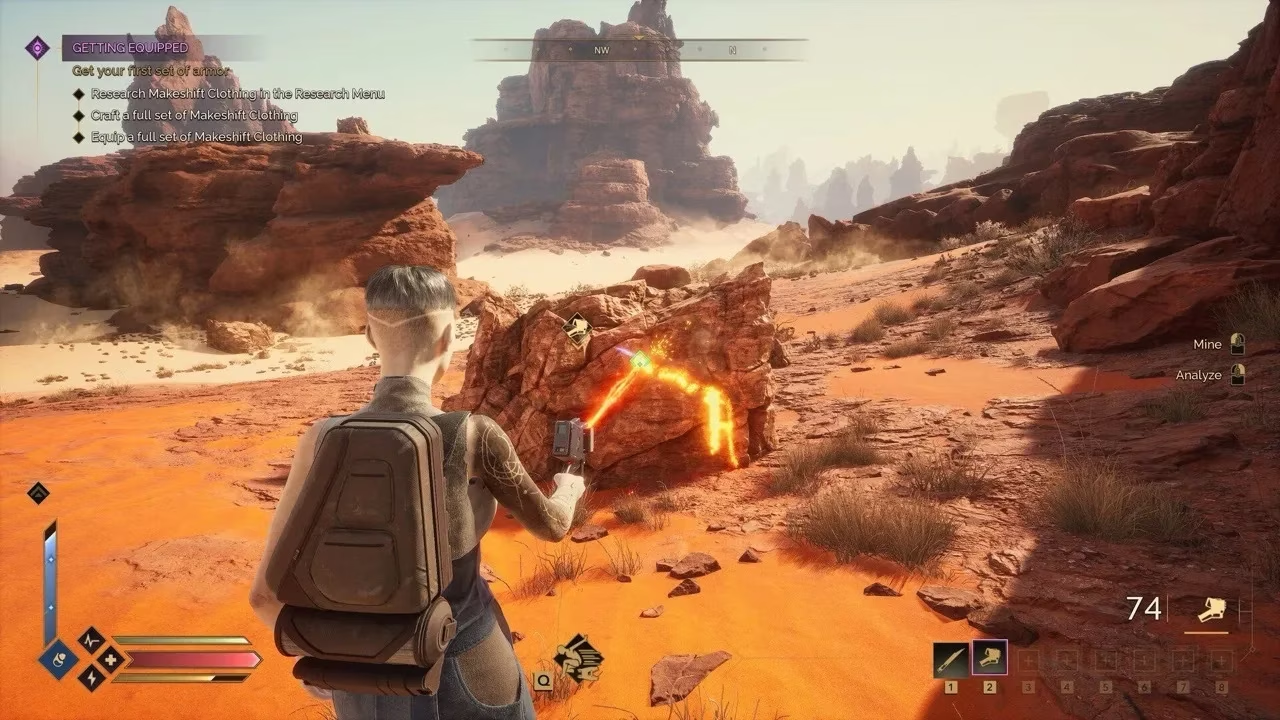
At first glance, Dune: Awakening plays like a typical survival game, albeit an extremely polished one. Players gather resources, craft items, and build shelter. There is at least some overarching direction, as the game directs players to craft certain items and gather required materials necessary for surviving life on Arrakis.
Rather than punching rocks, players fashion a makeshift Cutterray that is used to gather resources, done by scanning an object and then tracing a path with a laser beam to dismantle it. Since gathering resources is a big part of Dune: Awakening, it’s no small feat that even one of the game’s most basic pieces of moment-to-moment gameplay manages to keep attention dozens of hours later.
Funcom smartly revolves nearly all of Dune: Awakening’s survival mechanics around the need for water. Players need to stay hydrated and stick to the shade, as staying in direct sunlight for too long will quickly cause sunstroke that, if left unchecked, results first in dehydration and then in death. At first, players will likely be barely scraping by, harvesting dew from tiny plants and extracting the blood from enemies in order to survive. But it’s not too long before water becomes less about survival and more of a currency. Items start requiring water to be crafted, and soon, efficiently gathering water becomes a core gameplay loop.
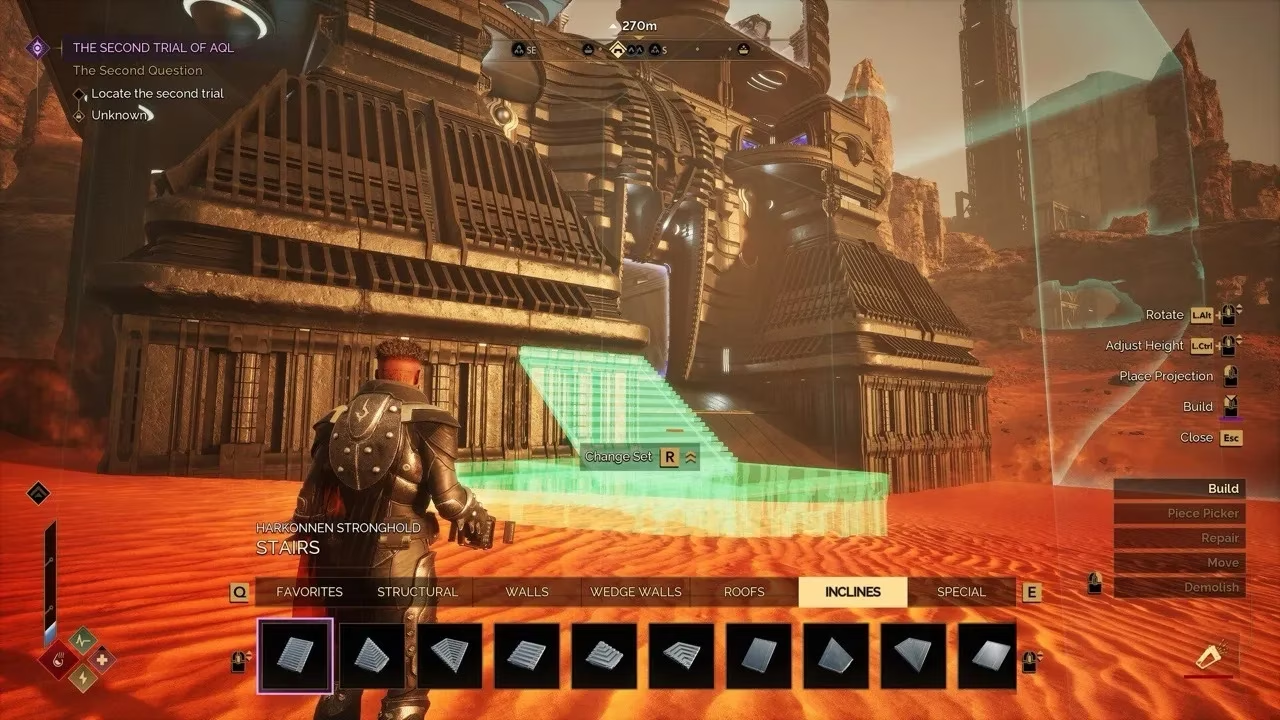
What about base-building? For many survival-game skeptics, it can feel like a chore, but Dune: Awakening makes base-building extremely simple for those who want to do the bare minimum. Walls, roofs, and floors all connect together rather seamlessly, and there’s no need to run power cables to various machines. Fuel for the base is easy to come by and things, by and large, just work. Refineries and fabricators pull from storage containers inside a base, minimizing the need for constant inventory management, and shifting power from one structure to another is all fairly simple. In a smart innovation, bases can also be saved as shareable blueprints that can then be easily re-constructed in a different location later with the press of a button, assuming the player has the proper resources.
The Terror and Triumph of Crossing the Desert
It’s after these first few hours, once players have crafted their first water-collecting stillsuit and built a barebones base, that Dune: Awakening begins to come into its own. There comes a point around this time where players will inevitably need to cross a large body of sand. That is, of course, where Dune’s iconic sandworms live, and carelessly sprinting across the open desert is a surefire way to attract their attention.
While normally death in Dune: Awakening is a relatively low-risk affair, only resulting in the loss of some held resources and currencies, as well as item durability, getting eaten by Shai’Hulud holds bigger repercussions. Dying to a worm means losing everything on the body at that point in time. All armor, weapons, resources, money. All of it. And there’s no way to get it back. That gives some real stakes to crossing the desert: a feeling of danger that never truly goes away, even after crafting the first vehicle.
A feeling of progression and mastery over a harsh, untamed land is something that Dune: Awakening does especially well. While players start in nothing but rags, it’s not long before they find or craft a suspensor belt, allowing them to more easily climb or fall from higher elevations thanks to anti-grav technology. A few hours later, they can craft their first sandbike. Suddenly, the world of Arrakis opens up, as players can now cross larger bodies of sand more quickly and explore new areas. Funcom pulls this magic trick again dozens of hours later once players have accumulated the resources to make their first flying Ornithopter. Once again, the game changes dramatically, and previously inaccessible or hard-to-reach areas are now just a short flight away.
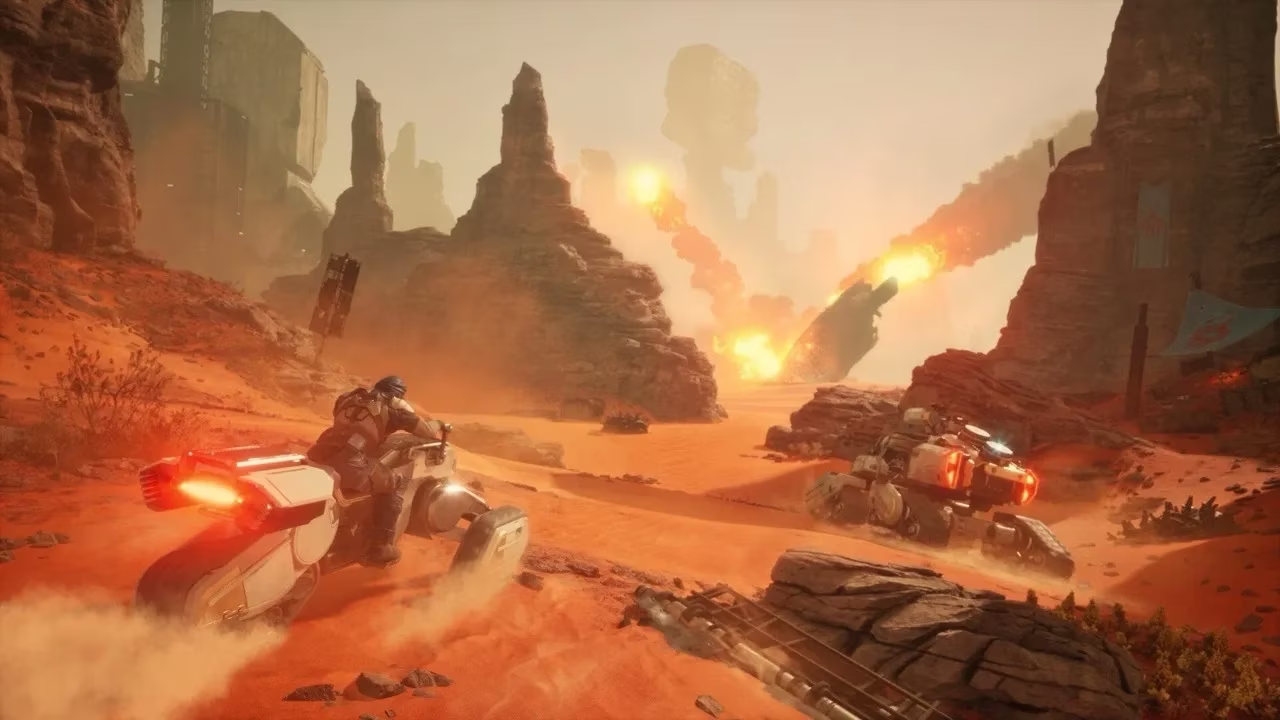
But those same vehicles can also lure players into a false sense of security. Is it really possible to outrun an angry Shai’Hulud on a sandbike? It isn't. On one sandworm death, the player was presented with a Fremen vision, after which they were given the chance to recover the sandbike just this once. The offer was gladly accepted, only to die by a sandworm again a few hours later. This time it was because of driving into a patch of quicksand. As the player thrashed about trying to escape, the worm came and ended their suffering. Thankfully, the sandbike was saved before death by storing it in some kind of pocket dimension using the game’s handy vehicle-backup tool, one of the extremely few instances in Dune: Awakening where gameplay convenience overrides established Dune lore.
The Core Loop: Survey, Clear, Craft, Repeat
Unlocking the sandbike is where Dune: Awakening truly finds its rhythm, as the world, for the most part, becomes yours to explore. The first arc of the game’s main story fits nicely into this pattern, tasking players with exploring the world to discover Fremen shrines sprinkled across the game’s various regions, where they learn more about Fremen culture and gain the ability to craft iconic desert-survival tools like thumpers.
Crafting higher-end recipes requires finding different materials found only in specific regions of the map, encouraging players to slowly progress through the world. Unlocking those crafting recipes, in turn, requires intel points, which are gained from leveling up and finding intel hidden inside enemy NPC encampments. Players who like to clear out a region of the map almost in its entirety before progressing to the next often find they have far more intel points than they know what to do with, as they roam from enemy camp to enemy camp, cutting their way through enemies as a melee-focused Swordmaster.
Aside from gathering resources and base-building, this is the core loop of Dune: Awakening: Survey a region, clear out enemy camps, gain intel, learn crafting recipes, make better gear, and progress to a new area. Rinse and repeat.
Combat: The Slow Blade Penetrates the Shield
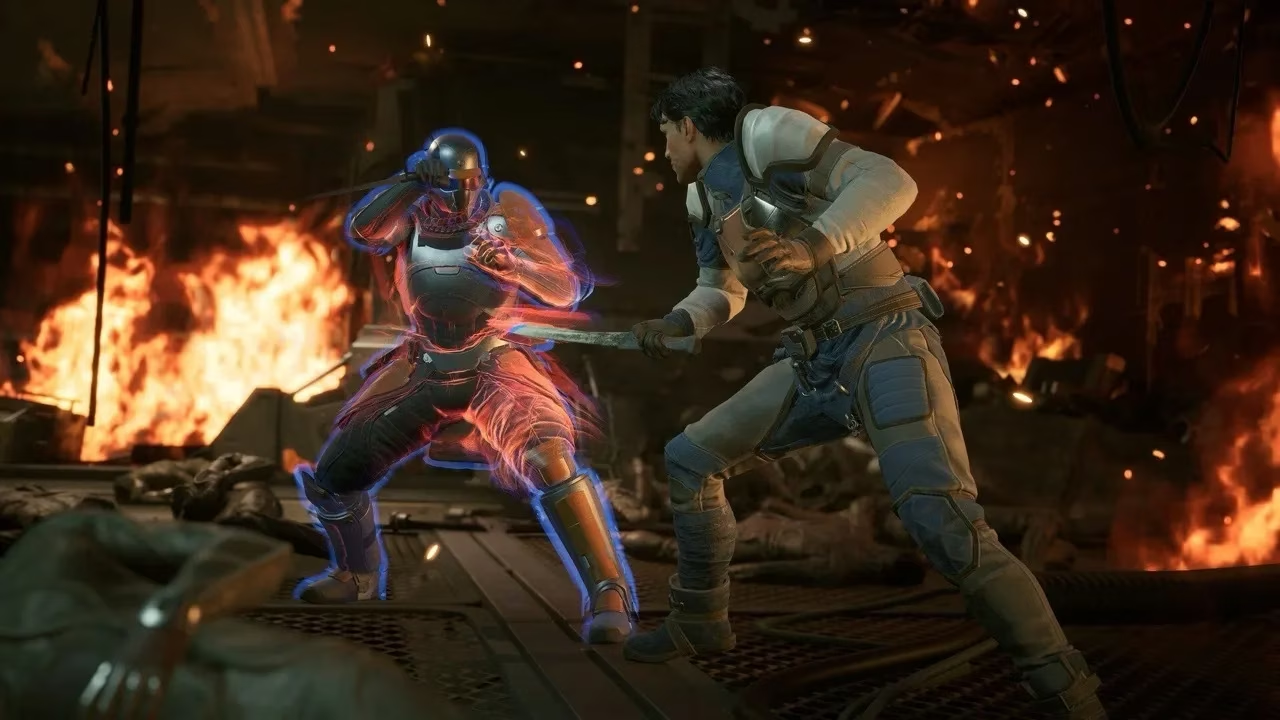
It’s a loop that sustains itself for dozens of hours, even if combat isn’t Dune: Awakening’s strongest feature. The Dune universe’s unique setting, one where soldiers still use knives and swords thousands of years into the future and wear shields that practically make them invulnerable to firearms, does make for some fun rock-paper-scissors-like encounters. Using lore-accurate slow-blade attacks to penetrate enemy shields is always satisfying thanks to the game borrowing some of the same visual and audio cues from Villeneuve’s Dune films. There are also ranged weapons in the form of various dart-guns that come in pistol, assault rifle, sniper, shotgun, and minigun varieties.
Why does the Drillshot stand out among ranged weapons? It fires slow penetrating darts that are excellent for disabling shields, allowing a player to then quickly close distance and engage in melee. It’s all fairly basic in terms of actual gameplay—there is a stamina bar, a parry button, and short-ranged dash—but it gets the job done. The presence of shielded enemies who are nearly invincible unless dealt with in the proper way manages to keep encounters from quickly becoming boring.
However, it certainly feels like Funcom, in staying true to Herbert’s lore, ran into the issue of being unable to deliver greater variety when it came to Dune: Awakening’s enemies and locations. There are no thinking machines (aka robots) in the Dune universe. Nor are there aliens or outlandish monsters, aside from the sandworms. That means players are relegated to exclusively fighting similar-looking humans that come in just a few different forms—knife-wielding melee enemy, ranged assault rifle enemy, ranged sniper enemy, and shielded heavy enemies who use either a minigun or flamethrower. Some late-game enemies will use some of the same abilities players have access to, like anti-gravity fields or Bene Gesserit kung-fu, but these barely change the math of an encounter.
The Endgame Problem: A Pointless Desert?
It’s a shame that class abilities, ones that players have gotten accustomed to and experimented with for dozens of hours, become largely forgotten in Dune: Awakening’s heavily Ornithopter-based endgame. Once players can create an Ornithopter, they have access to a new map called the Deep Desert. Though the layout of the Deep Desert map changes weekly, it’s where the game’s best crafting recipes and most valuable resources, including the largest amounts of Dune’s oh-so-important Spice, can be found. Players need a lot of Spice and other materials to make the game’s final tier of gear and base facilities. To call it a grind would be an understatement.
Until recently, almost all of the Deep Desert was a PvP-enabled zone where other players could battle over resources. That largely resulted in large guilds or groups of players using their Ornithopters to bully solo players from the air, with ground-based fights using the game’s melee combat or third-person shooting practically nonexistent. To its credit, Funcom has at least realized that having Dune: Awakening’s endgame be almost entirely controlled by roaming helicopter death squads isn’t a fun experience. As of a recent patch, around half of the Deep Desert is now player vs. environment, allowing solo players or those who don’t want to engage in PvP a chance to gather some endgame resources, though the largest quantities of them are still found deeper in the PvP-enabled area of the zone.
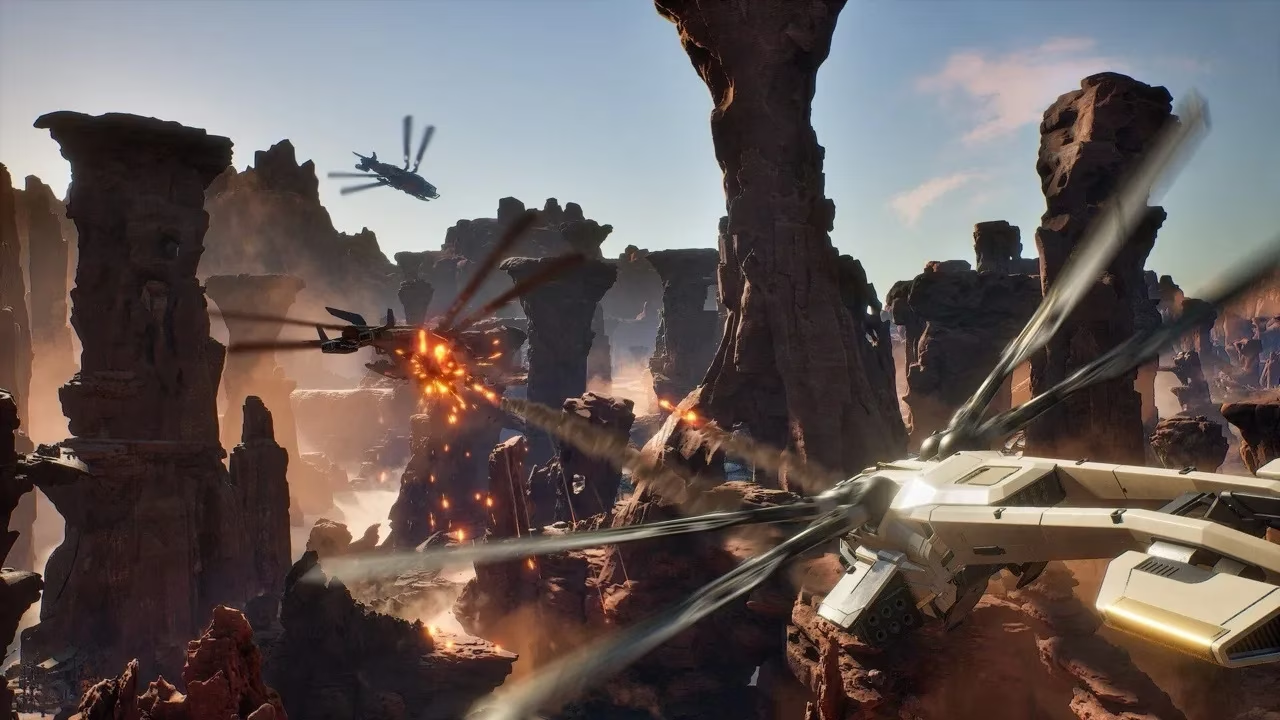
While Funcom has addressed some of Dune: Awakening’s endgame issues, its largest problem still stands: There is simply not much point in grinding for dozens more hours to acquire thousands of Spice and endgame materials. There is no endgame raid or difficult PvE challenge that requires, or at least would be made easier by, having the best-of-the-best gear. In the Deep Desert, players are largely doing exactly what they’ve already been doing for hours in Hagga Basin: clearing out camps, mining resources, and diving into Imperial Testing Stations for rare recipes. Sure, gearing up in the highest-quality gear and weapons is fun, and becoming a multi-millionaire by running a sophisticated Spice-mining operation has its perks, but unless a player is looking to get an advantage in PvP, there is no carrot on a stick for continuing to deal with Dune: Awakening’s repetitive, grindy, and pointless-feeling endgame.
Is Dune: Awakening Worth It in 2026?
Most players will likely quit shortly after completing Dune: Awakening’s main story and arriving at the Deep Desert. But that doesn’t mean all the hours prior to reaching the endgame aren’t worth experiencing or aren’t enjoyable. Funcom has turned Herbert’s legendary sci-fi planet of Arrakis into a captivating video game setting. Part story-driven RPG, MMO, survival base-builder, sci-fi helicopter simulator, and third-person shooter, Dune: Awakening is a multi-headed hydra of experiences that, somehow, coalesces into a largely satisfying whole.
Here is a quick breakdown of what Dune: Awakening gets right and wrong:
| ✅ Strengths | ❌ Weaknesses |
|---|---|
| Stunning world design that makes Arrakis feel alive | Repetitive enemies and activities |
| Water-based survival loop that stays engaging | Endgame lacks meaningful goals |
| Hassle-free base building with shareable blueprints | Mission-board quests feel like MMO filler |
| Vehicle progression that opens up exploration | Combat is basic and can grow stale |
| Faithful Dune lore with creative alternate timeline | Strict lore limits variety in locations and enemies |
While it suffers from a serious lack of variety when it comes to enemies and activities, and its endgame as of writing is a largely pointless endeavor with no real goal to strive for, Dune: Awakening nonetheless succeeds at bringing the universe of Dune to life in a way never before seen. When the Spice is flowing, it’s easy to lose oneself to the rhythms of Dune: Awakening’s desert for hours at a time. Just take care not to attract Shai-Hulud.
COMMENTS