Alright, let me put on my stillsuit and pour myself a tiny, precious sip of reclaimed water. I need to be sharp for this. You see, I've been wandering the endless sands of Arrakis in Dune: Awakening, and let me tell you, it’s less of a game and more of a… well, a very expensive, beautifully rendered therapy session where the therapist is a giant sandworm and the only coping mechanism is not dying of thirst. From the moment you stumble out of the tutorial, blinking in the twin suns' glare, the pressure starts. It’s not the ‘oh no, I might lose some loot’ pressure of other games. It’s a deep, primal hum that vibrates in your bones. The game presents itself as a survival MMO, but after a few dozen hours, I’m convinced it’s a brilliant, sadistic psychological experiment disguised as entertainment. It doesn’t just test your skills; it holds up a mirror to your soul and asks, ‘How do you handle the abyss?’ Spoiler: my answer involved a lot of panicked running.
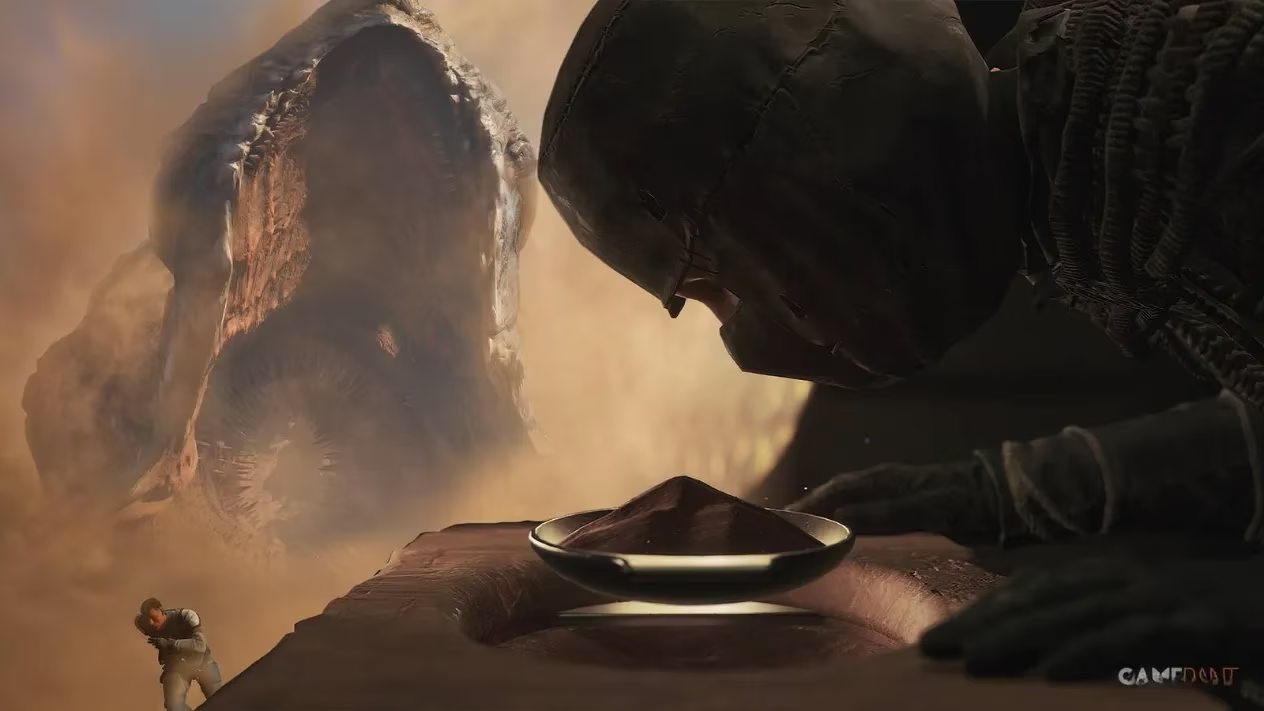
The core of this experiment is survival, but not as a temporary state. In Dune: Awakening, survival is a permanent, grating background noise that frequently decides to become a heavy metal concert right in your face. It never leaves. You’re not just ‘surviving’ between quests; you are being survived against by the entire planet. The mechanics are relentless by design. It’s not punishing for ‘realism’—it’s punishing to see what you’ll do.
Let’s break down the enemies, shall we? This isn't your standard MMO foe list.
-
The Sun: Not a backdrop. An active, malicious entity slowly cooking your brain in your skull. Sunstroke isn’t a debuff; it’s a countdown to a fuzzy, hallucinatory demise.
-
Dehydration: Your water is your life, your currency, and your most paranoid obsession. You’ll dream about dew collectors.
-
The Sand: It’s not just ground. It’s quicksand that swallows you whole, storms that sandblast your skin off, and a shifting landscape that laughs at your carefully drawn map.
-
The Worm: Shai-Hulud. The maker. You don’t fight it. You pray your rhythm is wrong and you’re not tasty. Its ever-present threat is more powerful than any actual attack.
Every single step across the dunes is a risk assessment. Standing still is a risk. Breathing feels like a risk. And the game just… watches. It doesn’t reward a particular playstyle. It observes. Faced with this constant, low-grade terror, players lean into their basest instincts. Do you become a paranoid prepper, hoarding every drop of water and building labyrinthine shelters? Or do you become a desert gambler, sprinting into dust storms with a canteen half-full, betting your life on finding an oasis? The game doesn’t care. But you learn something about yourself.
This is where the ‘psychological experiment’ part truly shines. The environment strips away the polite social veneer of typical MMOs. You’re not choosing a ‘class’; you’re revealing a coping mechanism.
| Observed Player Archetype | Their Manifested Behavior in Arrakis | What It Probably Says About Them |
|---|---|---|
| The Controller | Builds massive, multi-layered bases in ‘safe’ zones. Has spreadsheets for resource decay. Never travels without 3x the needed supplies. | Seeks order in chaos. Deeply uncomfortable with uncertainty. Probably has a very tidy kitchen. |
| The Gambler | Wears minimal gear. Constantly probes the Deep Desert. Views near-death by dehydration as a ‘fun challenge’. | Thrives on adrenaline. Values freedom over security. Likely has unpaid parking tickets. |
| The Parasite | Rarely builds. Follows stronger players. ‘Accidentally’ picks up resources you dropped in a fight. | Pragmatic to a fault. Masters of social leverage. Would survive a zombie apocalypse but you’d hate them for it. |
| The Hermit | Exists on the absolute fringes. Interaction is a last resort. A master of solitude and stealth. | Deeply self-reliant or deeply misanthropic. Possibly both. Their base is a legend no one has ever seen. |
And then there are relationships. Ah, cooperation! In other games, you group up to tackle a dragon for epic loot. In Dune: Awakening, you group up because the sheer, grinding exhaustion of doing everything alone has broken your spirit. 😩 It’s not about friendship; it’s about distributed labor. You don’t say, ‘Hey, let’s quest together!’ You say, ‘If you watch my back for sandworms, I’ll share my fungus beer.’ It’s a partnership of convenience forged in the sweaty, desperate crucible of mutual need. Traveling together just means you’ll hear the worm a few seconds sooner as it eats your new ‘friend’ first.
This transactional mindset seeps into everything, especially base-building. There’s no point building a glorious palace. The game’s systems have decay and server wipes baked right in. Your beautiful spire of ceramic and steel will be a sand-swept ruin in time. Knowing this changes you. You build what is necessary: a water still, a spice refinery, a bed. It’s a temporary pit stop, a burrow to weather a storm. This lack of permanence is the final masterstroke of the experiment. For some, it’s demoralizing. ‘Why build anything if it will be gone?’ They wander, making little progress, slowly succumbing to the elements. For others, it’s liberating! It pushes them to be more daring, to do more now, because tomorrow the save file might be wiped clean by a Coriolis storm.
In the end, after all the sand, the spice, and the sheer terror, Dune: Awakening isn’t trying to tell you who to be. It has no grand narrative about heroes. It simply creates the harshest, most indifferent playground imaginable and throws you in. Its brutality acts as a mirror. 👁️ It reveals your personal thresholds for control, your capacity for trust (or lack thereof), your relationship with challenge, and your ultimate response to overwhelming pressure—do you fight, flee, or surrender to the desert?
By stripping away the comforting structures of traditional MMOs—safe hubs, clear progression paths, permanent rewards—it pushes you to a point of raw, instinctual gameplay. It’s a thrill ride, not because of the action (though the worm attacks are heart-stopping), but because of the profound self-discovery that comes from navigating its beautiful, terrible sands. You don't just leave Arrakis with better gear; you leave with a better, or at least a more starkly revealed, understanding of yourself. Now, if you'll excuse me, my water discipline is low and I think I hear a rhythmic scraping in the sand...
COMMENTS