Let me tell you, as someone who's logged more hours in Dune: Awakening than I care to admit, the game's launch in 2026 has been a wild ride. It captured the hearts of survival fans and Dune purists alike, with servers buzzing and player counts soaring. We've all been chasing that perfect blend of spice, survival, and sandworm encounters. But as I've journeyed deeper, the landscape of my experience has split into two starkly different realities. It's a story of a world masterfully built and another that feels hauntingly, intentionally empty—almost too well done for its own good.
For the most part, Funcom nailed the core experience. The initial thrill of surviving in the Hagga Basin is like being a kid in a sandbox filled with priceless, glittering treasures. Every dune holds a secret, every rock formation tells a story. The environment isn't just a backdrop; it's a character. The sprawling Eco Labs feel like living, breathing ecosystems you can get lost in for hours, a delicate clockwork of survival mechanics ticking away. The movement, the gathering, the constant threat of other players and the environment—it all clicks together like a perfectly calibrated stillsuit.
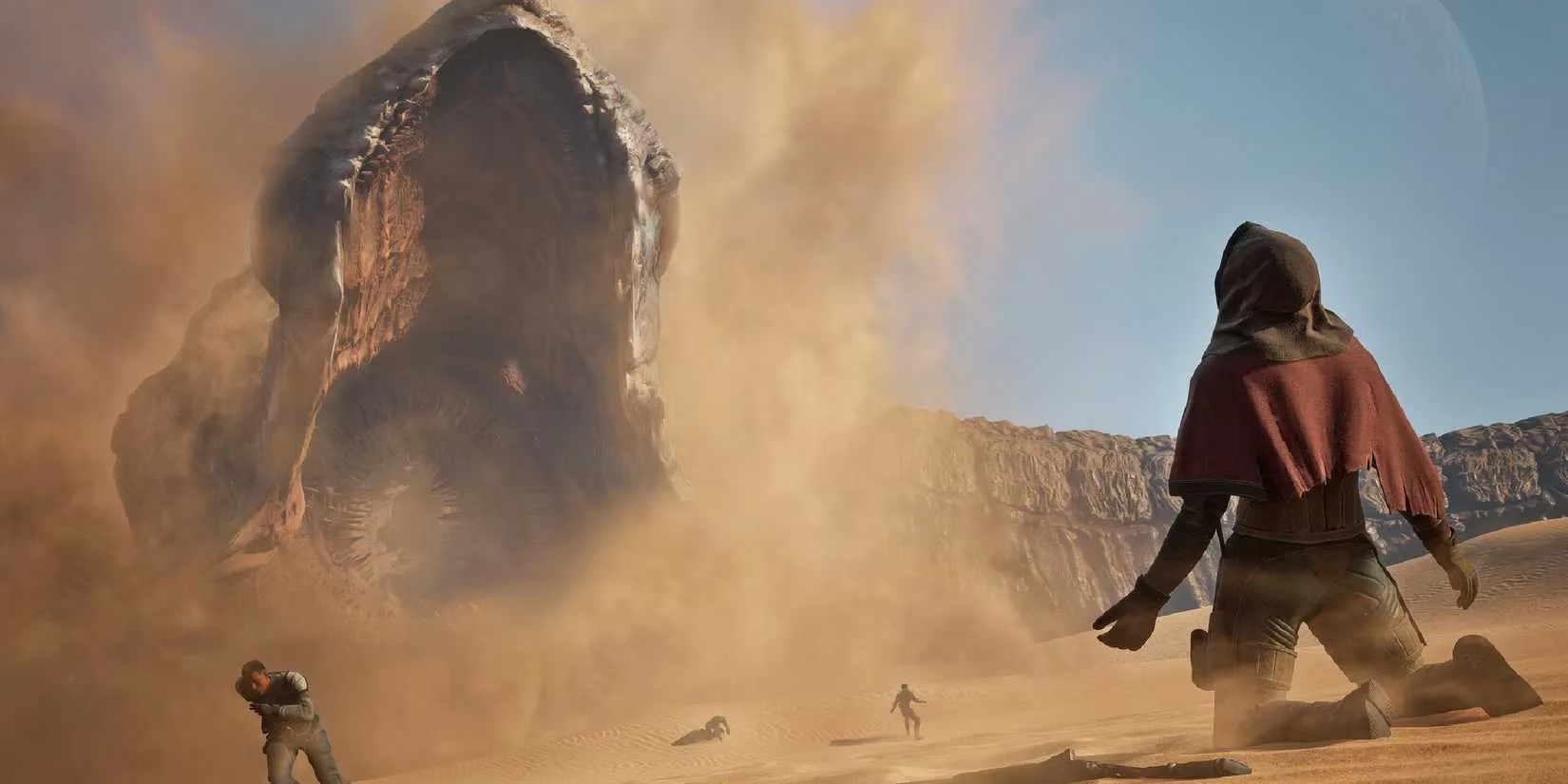
But then, you reach the Deep Desert. The game's designated endgame and PVP zone. And friends, the shift is jarring. It's like stepping out of a vibrant, noisy bazaar and into a soundproofed, white-walled room. The transition is so severe it feels less like a new biome and more like the game developers accidentally left the 'placeholder terrain' toggle on. The community sentiment, which I wholeheartedly share, is captured perfectly by a fellow player, AlphaAron1014. They said, and I quote, "They managed to take something described as a lifeless desert and truly deliver on that, scarily well…"
Let me break down why the Deep Desert feels like such a regression:
-
The Gameplay Loop Grinds to a Halt: In the Basin, you're exploring, building, engaging in dynamic encounters. In the Deep Desert, the loop becomes a monotonous chore. You're not playing a survival game anymore; you're running a tedious errand simulator. Your research tree dangles a carrot—two new types of materials—and your spice addiction forces you to chase it.
-
The Soul of Exploration is Gone: The lovingly crafted landmarks of the Hagga Basin are replaced by… nothing. Procedurally generated dunes stretch to the horizon with no points of interest. It's a visual desert in the most literal and boring sense.
-
Movement Becomes a Punishment: This is the big one. Gone is the tense, on-foot traversal. It's replaced by gliding for minutes at a time in a Thopter. You fly in silence, land, grab some rocks, and fly back. Our own Harry Alston called it a "flight simulator," and he's spot on. I've never seen another player on foot there either. The zone is as socially barren as it is visually.

The community reaction hasn't been subtle. Diving into the subreddit feels like attending a support group for disappointed explorers. User DocJokin3C summed it up: "Dry Desert feels like a different game entirely. They absolutely cooked with the Basin, and then you get to DD, and it’s, for the most part, completely devoid of any meaningful content." Colonel_Chow pointed the finger at procedural generation, calling the Deep Desert "lifeless and limp" compared to the "lovingly crafted" Basin.
This creates a real problem for the game's longevity. The complaints about endgame viability for solo players were already a cloud on the horizon. Now, with the environment itself being criticized, that cloud has turned into a Coriolis storm. If the ultimate goal, the 'reward' for dozens of hours of play, is to enter this barren, repetitive space, what's the incentive to keep going? The endgame currently feels less like a challenging new frontier and more like a beautifully rendered waiting room.
For me, playing in the Deep Desert is like being an archaeologist asked to study a perfectly blank, factory-made slab of concrete. The promise of discovery is utterly absent. Conversely, the thrill of the Hagga Basin is as precise and satisfying as a Mentat solving a complex logistical problem. The difference in quality is so stark it feels like two different development teams worked on these zones, separated by a decade of design philosophy.
So, where does Dune: Awakening go from here in 2026? The potential is massive. The foundation in the Hagga Basin is rock-solid. But Funcom has its work cut out. The Deep Desert needs more than just a fresh coat of sand. It needs:
-
Hand-Crafted Landmarks: Introduce mysterious ruins, massive spice blows, hidden Fremen sietches, or crashed ships that tell a story.
-
Dynamic Events: Sandworm attacks of biblical proportions, sudden Coriolis storms that change the landscape, or rare, timed spice harvests that draw players into conflict.
-
Meaningful PVP Objectives: Right now, there's no reason to fight. Add control points, extractable high-value resources, or faction-based territories to fight over.
-
Reworked Mobility: Make the Thopter a tool, not a necessity. Add deployable grapple points, sand-skiffs for dune surfing, or even limited worm-riding for the truly brave.
The game has captivated us, but to keep us engaged for the long haul, it needs to ensure its entire world is as compelling as its brilliant first act. The Deep Desert shouldn't be a punishment for reaching the endgame; it should be the ultimate reward.
According to coverage from PEGI, an important part of evaluating a game’s long-term appeal is understanding how its endgame systems shape player behavior—especially when a zone is positioned as high-stakes PVP. In the context of Dune: Awakening’s Deep Desert, the reliance on repetitive resource runs and largely empty traversal can inadvertently discourage the very social friction and emergent encounters that keep competitive regions active, making it harder for players to justify returning once the initial material grind is complete.
COMMENTS